
 English
Customize non-standard offline monitoring instruments based on product usage environment and requirements description. The product material is copper foil. Thickness 0.006MM-0.07mm. The maximum width is 1450MM. The measurement accuracy is+/-0.02mm, and it has data network communication and USB serial port. Implement network data transmission function.
This instrument is used for offline monitoring of copper foil thickness and weight. Display the thickest and thinnest thickness, as well as the average thickness curve. Display the weight of the material.
2. The instrument is not used in conjunction with online measurement and production lines. But it is placed separately in the laboratory or warehouse. For the already produced rolled copper foil material. Conduct thickness measurement and weight measurement monitoring.
3. The instrument uses non-contact X-ray principle. Penetrating materials. By material composition absorption and area. Density. Calculate the weight in grams. Finally converted to thickness value. Not affected by material color and thickness. Just need to use it for the first time. Take out a piece of material. Place the X emitter and receiver in between. Open manual mode. Read the penetration value and press save. No calibration is required in the future. Unless it is necessary to calibrate or replace materials with different compositions. Because copper foil is a negative electrolytic material. The density is basically fixed. Just the copper content and composition are different. Different purposes. Copper foil has low surface oxygen characteristics. Generally divided into (self-adhesive copper foil) and (single conductive copper foil). (Double electronic grade copper foil). Among them, electronic grade copper foil has the highest usage. It is a layer of metal material deposited on the substrate of a circuit board. The commonly used thickness is generally within 100 microns. Commonly used for conductive circuit boards and electronic components in PCBs. The production process is divided into rolling production line and electrolytic production line. Other copper foils are commonly used as decorative materials.
4. The above are commonly used copper foil materials. Another type is carbon coated copper foil. Mostly used in the battery industry. The material is different from the above.
5. Taking into account the material properties and composition mentioned above. Using offline measurement is a monitoring and quality control of finished products. A material unwinding section is required. Material winding position. Only then can offline measurement of copper foil products be achieved.
6. The instrument uses Windows system industrial computer. An IN acquisition software developed and operated based on the W7 system. Capable of data collection and analysis. Network communication. Online and offline printing and transmission functions.
7. The following is a schematic diagram of offline measurement of the instrument.
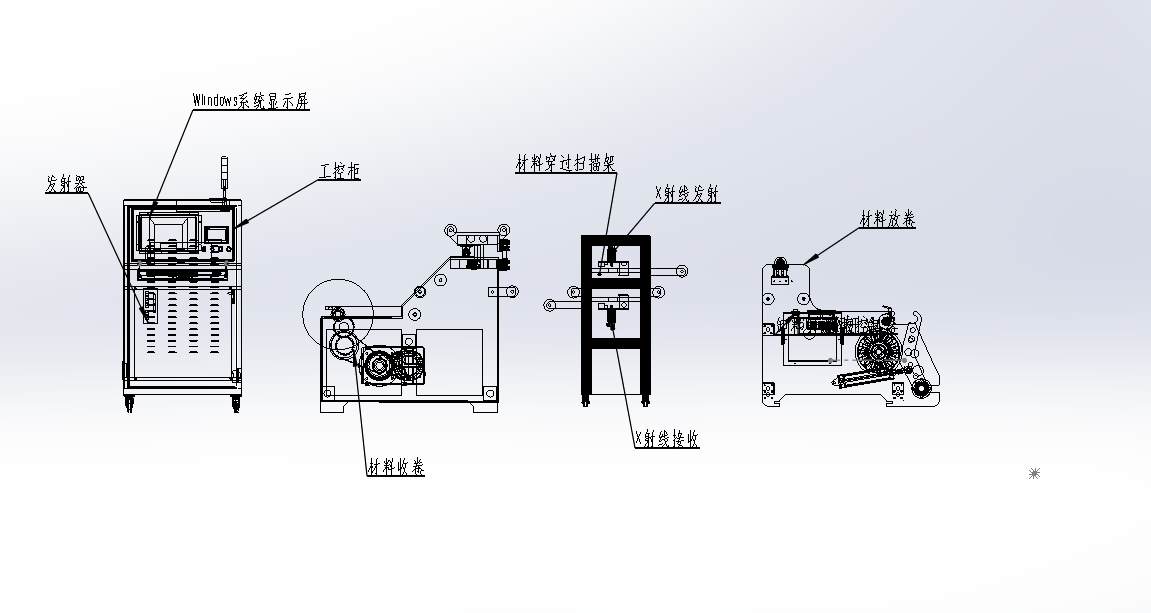
8. The above plan is for reference only. The disadvantage is that if different components of the material are used, it only needs to be calibrated once. Or retrieve and use it from the saved records.
There is another option that does not require calibration. The process is the same as the above plan. It is also necessary to equip a winding mechanism and a unwinding mechanism. The principle is based on laser emission measurement. The advantage is that there is no need to calibrate the composition of different materials. The cost will increase. If the cost is acceptable. Consider using laser.
10. The following is a brief introduction to copper foil materials.
1. Copper foil
Pure copper skin refers to the metal copper layer used for pressing copper-clad laminates or the metal copper layer used for the outer layer of multi-layer boards in printed circuits.
2. Electrodeposited copper foil (ED copper foil)
Copper foil made by electrodeposition. The manufacturing of electrolytic copper foil for printed circuit boards first involves producing the original foil (also known as "wool foil" or "raw foil"). The manufacturing process is an electrolytic process. Electrolytic equipment generally uses a surface roller made of titanium material as the cathode roller, with high-quality soluble lead based alloy or insoluble titanium based corrosion-resistant coating (DSA) as the anode. Copper sulfate electrolyte is added between the anode and cathode. Under the action of direct current, metal copper ions are adsorbed on the cathode roller to form electrolytic foil. As the cathode roller rotates continuously, the generated foil is continuously adsorbed and peeled off on the roller. Then it is washed, dried, and wrapped into a rolled original foil.
3. Rolled copper foil
Copper foil made by rolling method. Also known as forged copper foil.
4. Double treated copper foil
In addition to treating the rough surface of electrolytic copper foil, the smooth surface is also treated to roughen it. Using this as the copper foil for the inner layer of a multi-layer board does not require roughening (blackening) treatment before laminating the multi-layer board.
5. High temperature elongation electrodeposited copper foil
(abbreviated as HTE copper foil)
Copper foil that maintains excellent elongation at high temperatures (180 ℃). Among them, the elongation at high temperature (180 ℃) of copper foils with thicknesses of 35 μ m and 70 μ m should be maintained at more than 30% of the elongation at room temperature. Also known as HD copper foil.
6. Low profile copper foil (LP)
The microcrystals of the original copper foil are generally very rough, appearing as coarse columnar crystals. The cross-sectional lines of its slices have significant undulations. The crystallization of low profile copper foil is very delicate (below 2 μ m), with equiaxed grains and no columnar crystals, presenting as layered crystals with flat edges. The surface roughness is low. The ultra-low profile electrolytic copper foil has been measured to have an average roughness (Ra) of 0.55 μ m (usually 1.40 μ m for copper foil). The maximum coarsening degree is 5.04 μ m (usually 12.50 μ m for copper foil).
7. Resin coated copper foil (RCC)
Also known as resin coated copper foil domestically. Taiwan refers to it as adhesive backed copper foil. In foreign countries, there are also insulation resin sheets carried on copper foil and adhesive films with copper foil. It is a process of coating one or two layers of specially composed resin adhesive solution (the main component of resin is usually epoxy resin) on the roughened surface of thin electrolytic copper foil (thickness generally ≤ 18 μ m), and then drying it in an oven to remove the solvent, and the resin becomes a semi cured B-stage form. The thickness used for RCC generally does not exceed 18 μ m, with 12 μ m being the most commonly used. The thickness of the resin layer is generally between 40-100 μ m. It plays a role in replacing traditional semi cured sheets and copper foils in the production process of laminated multilayer boards. As an insulating medium and conductor layer, it can be pressed together with the core board using a similar process to traditional multilayer board pressing to produce laminated multilayer boards.
8. Adhesive coated copper foil (ACC)
Also known as' glued copper foil '. Copper foil products coated with resin adhesive on the roughened surface of copper foil. The general types of resin adhesives include aldehyde modified phenolic resin, epoxy acrylic resin, nitrile modified phenolic resin, etc. Adhesive coated copper foil and resin coated copper foil (RCC) differ in function, serving only as an adhesive between the copper foil and the insulating substrate. Used for manufacturing paper-based copper-clad laminates and three-layer flexible copper-clad laminates.
9. Lithium ion batteries require copper foil for lithium ion battery
Copper foil used in the manufacture of negative electrode current collectors for lithium-ion batteries. This copper foil serves as both a carrier for negative electrode materials and a collector and transporter for negative electrode electrons in lithium batteries. The copper foil used must have good conductivity. It should ensure good contact with the active substance and be evenly coated on the negative electrode material without peeling off. It should have good contact with activity, good corrosion resistance, smooth surface, and uniform thickness.
10. Ultra thin copper foil
Copper foil for printed circuit boards with a thickness of less than 9 μ m. The commonly used copper foil has an outer layer of 12 μ m or more on multi-layer boards and an inner layer of 18 μ m or more on multi-layer boards. Copper foil below 9 μ m is used on printed circuit boards for manufacturing micro circuits. Due to the difficulty in handling extremely thin copper foil, a carrier is generally used as a support. The types of carriers include copper foil, aluminum foil, organic film, etc.
11. Type of foil
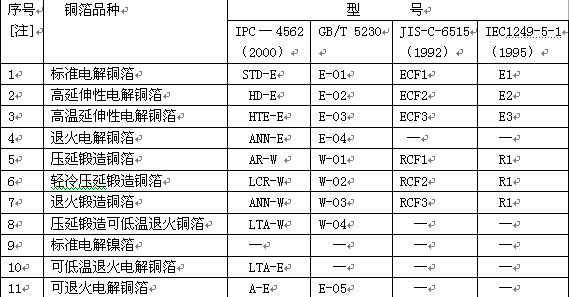
IPC-4562 specifies the types and codes of metal foils based on their manufacturing processes
E - Electrolytic foil
W - Rolled foil
O - Other foils
12. Type of foil: foil grade
Various copper foils were labeled with English letters. As a variety of copper foil models.
Compare the models of various copper foils specified in IPC-4562 (2000) with those named in other standards in the table.
Table
13. Raw copper foil
Untreated foil (also known as "raw foil" or "hairy foil" in China) produced in an electrolytic machine (electrolytic cell). Raw copper foil is manufactured on this device.
14. Surface treatment
It is an important link in the production of copper foil. It includes roughening treatment, barrier treatment (also known as heat-resistant layer treatment), and anti rust treatment (also known as anti-oxidation treatment) on copper foil.
15. Rough layer treatment
To achieve higher adhesion strength between copper foil and substrate, a nodular treatment is carried out on rough surfaces
16. Barrier treatment
Also known as heat-resistant layer treatment. In order to improve the heat resistance and high-temperature peel strength of copper foil pressed copper-clad laminates and multilayer boards, other metal layers are electroplated on the roughened layer of copper foil. This prevents direct contact between the bare copper surface and the substrate, avoiding the problem of water vaporization caused by the decomposition of the curing agent melamine in the resin due to high temperature, which may lead to the generation of bubbles and separation of copper foil and substrate.
17. Blackening treatment
Black roughening treatment again. A type of heat-resistant layer treatment. Coat another layer of nickel on the roughened surface. The color of the nickel plating layer is black, hence it is called blackening treatment. This type of copper foil is called nickel plated copper foil.
18. Yellow rounding treatment
A type of heat-resistant layer treatment. Coat another layer of copper zinc alloy (i.e. brass) on the roughened surface. The color of the copper zinc alloy layer is yellow, hence it is called yellowing treatment. This type of copper foil is called brass plated copper foil.
19. Anti rust treatment
Also known as anti-oxidation treatment, passivation treatment, and stability treatment. Copper foil treated with rust prevention is less prone to oxidation, discoloration, and rusting.
20. Rough surface matte side
Electrolytic copper foil (generally referring to the original foil) has a rough and matte surface, which is the side that does not adhere to the cathode roller during production. Compared to the light surface, it is called the hair surface. Also known as treated side.
21. Smooth shiny side
The bright surface of electrolytic copper foil, which is the side attached to the cathode roller during production. Also known as drum side copper foil. The roughness of the smooth surface is a replica of the roughness of the cathode roller surface. Also known as Untreated Side.
22. Processed side
After roughening, nickel plating or zinc plating, the electrolytic copper foil has improved its adhesion to the substrate on one or both sides.
23. Crop Slitting
The electrolytic copper foil undergoes longitudinal cutting according to the specified size after surface treatment. Trimming is performed on a slicer.
24. Cutting
After surface treatment, the electrolytic copper foil is horizontally cut according to the specified direction and size. The copper foil is cut on a slicer.
25. Cathode cathode
The electrode that undergoes a reduction reaction, that is, the electrode that obtains electrons on the surface of the cathode roller in the electrolysis machine under the condition of passing current.
26. Anode anode
The electrode that undergoes oxidation reaction, that is, the electrode in the anode plate of the electrolysis machine that can receive electrons given by the reactants.
27. Current density
The current intensity passing through a unit area electrode is usually expressed in A/dm2. Unless otherwise specified, it generally refers to the negative current density
28. Electrolytic Forming Cell
In the electrolytic copper foil production industry, it is a synonym for "electrolytic machine". It is an important equipment for producing electrolytic copper foil It generally uses a roller with a titanium surface made of specialized titanium material as the cathode roller, and a high-quality lead silver alloy containing 1% silver (or a specially coated titanium plate) as the anode. Copper sulfate electrolyte is added between the anode and cathode, and under the action of direct current, copper metal precipitates on the cathode roller. With the continuous rotation of the cathode roller, copper continuously precipitates on the roller surface, and the precipitated metallic copper is continuously peeled off from the roller, then washed and dried, wound into a roll, and formed into the original foil.
29. Dimensional stable anode (DSA)
Also known as insoluble anode. A type of anode used in foil making machines. DSA uses titanium material as the support for the anode, and a special coating (such as a mixed ceramic conductive layer of iridium oxide and tantalum oxide) is hot coated on the inner arc surface along the titanium anode to enhance the long-term attack of high current. It exhibits a very stable size compared to lead anodes.
30. Tensile strength
The maximum tensile stress experienced when a specimen fractures under a tensile load applied under specified experimental conditions.
31. Elongation rate
The percentage of the incremental distance between the effective part of the specimen and the initial distance between the markings when the specimen fractures under tensile load.
33. Peel strength
The force required to strip a unit width of wire or metal foil from a copper-clad laminate or printed circuit board perpendicular to the board surface.
34. Base material
An insulating material that can form conductive patterns on it. The substrate material can be rigid or flexible, and can also be uncoated or coated with metal foil.
35. Laminated board
A plate-shaped material formed by laminating two or more layers of semi cured sheets (pre impregnated materials) and bonding them together under heating and pressure.
36. Copper clad laminate (CCL)
A laminated board covered with copper foil on one or both sides, used for manufacturing printed circuit boards, abbreviated as copper-clad board. The general manufacturing process of copper-clad laminates is: blending → impregnation → drying → cutting → lay up → lamination → trimming.
37. Single sided copper clad laminate
Copper clad laminates with copper foil on only one side.
38. Double sided copper-clad laminate
A double-sided copper-clad laminate with copper foil.
39. Inner core material
Often refers to the substrate of the inner layer of a multi-layer board. Also known as inner core layer copper-clad laminate.
40. Semi cured sheet (prepreg) prepreg (PP)
A sheet-like material that is impregnated with thermosetting resin and cured to stage B using fiber-reinforced materials. Also known as B-stage material and pre impregnated adhesive sheet.
41. Pre impregnated bonding sheet
The "semi cured sheet" of the same 40.
42. Phenolic cellulose paper copper clad laminate
A laminated board made of reinforced fiber paper and phenolic resin insulation substrate and covered with copper foil. Common XPC, XXXPC (non flame retardant) and FR-1, FR-2, FR-3 (flame retardant) models of copper-clad laminates belong to this type of board.
43. Epoxy glass fabric copper clad laminate
A laminated board consisting of an insulating substrate made of glass fiber cloth and epoxy resin, and covered with copper foil. The common G10, G11 (non flame retardant) and FR-4, FR-5 (flame retardant) models of copper-clad laminates belong to this type of board.
44. Composite copper clad laminate
A laminated board containing two or more different types or structures of reinforcing materials and covered with copper foil. The common CEM-1 and CEM-3 models of copper-clad laminates belong to this type of board. CEM-1 is a laminated board made of fiber paper containing epoxy resin as the core, covered with fiberglass cloth containing epoxy resin on the surface, and then covered with copper foil. CEM-3 is a laminated board made of fiberglass non-woven fabric (also known as fiberglass paper) containing epoxy resin as the core, covered with fiberglass cloth containing epoxy resin on the surface, and then covered with copper foil.
45. Thin copper clad laminate
Copper clad laminates with a thickness (including copper foil thickness) less than 0.8mm. Mostly used for the inner core material of multi-layer boards.
46. Ultra thin copper clad laminate
Copper clad laminates with a thickness (including copper foil thickness) of only 1.2-5 mil (0.030-0.127mm). Mostly used in the manufacturing of multi-layer boards.
47. Printed circuit board (PCB)
A printed circuit board is formed on an insulating substrate according to a predetermined design to interconnect electrical circuits from point to point, as well as printed components.
48. The above is a brief overview of copper foil materials. The specific introduction of the second plan is on the next page. Attached are engineering design drawings.
49. Use a voltage of 220V at 50Hz. Unwinding mechanism. Collection institution. All measuring institutions use bottom pulleys. Easy to move. Due to the heavy volume of the material. Has a certain degree of self adhesiveness and static electricity. Adopting a 6-inch inflatable shaft. Loading with air pressure. Pneumatic unloading. And tension control.
50. Measure the roll copper foil material. If it is only for small areas and local measurements. Usually, a micrometer or an ultrasonic manual thickness gauge is used. But for multi-point measurements of large areas and certain widths. The above large measuring instruments need to be selected. According to the maximum width of the product. Set the measurement points you want freely. For example, a width of 1000MM is 1 meter. You can set 1000 points. It's just 1MM per point. Display the measured thickness of 1000 points. Display the thickest point. The thinnest point. Flat curve distribution diagram. Display the weight of the material. Print as a reference record.


