
 English
Triple fold, no matter how you fold it, there is always a face
In September 2024, the Huawei Mate Xt Extraordinary Master Triple Folding Phone was officially released and quickly became popular on the internet with its interesting advertising slogan, attracting netizens to imitate it. Prior to this, foldable smartphones had already entered people's lives. In the current era of rapid technological development, after Ruoyu released the world's first smart foldable screen phone in 2018, major smartphone manufacturers began to develop and manufacture foldable screen phones. With its unique form and innovative user experience, foldable screen mobile phones have become the new favorite of the smartphone market. Major smartphone manufacturers have started the research and development, as well as manufacturing, of foldable screen smartphones. Nowadays, foldable screens are becoming increasingly popular in the market and are heading towards global adoption.

Traditional smartphone screen covers are made of a transparent hard board, which not only has transparency but also has certain strength and wear resistance, serving to protect the phone. But the screen cover of a foldable phone needs to achieve the functions of display, protection, and folding at the same time. So how can we make the screen cover transparent, strong, and flexible? Polymer materials provide us with a highly effective solution.
1. Performance requirements
As a material for mobile phone screen cover, it should have good brightness, ultra-high flexibility, good mechanical strength, good dimensional stability, and a certain degree of chemical corrosion resistance.
The clarity and color reproduction of the screen are important indicators for evaluating the performance of a mobile phone. The screen material should not absorb or scatter too much light, and the light emitted by the screen should be transmitted to the user's eyes without obstruction, presenting clear and vivid images and text, and bringing users a better visual experience; The flexibility and mechanical strength of screen materials greatly determine the bending resistance, collision resistance, friction resistance, and impact resistance of mobile phones; Good thermal performance and dimensional stability can ensure that the phone does not undergo significant deformation at higher and lower temperatures; And a certain degree of chemical corrosion resistance can effectively prevent the phone from coming into contact with various chemicals such as sweat and detergents during use, which can corrode and reduce its performance.
2. Transparent Polyimide (CPI) Film Material
In the field of smartphones, especially in the design of foldable screen phones, foldable ultra-thin glass (UTG) and transparent polyimide (CPI) are two important screen cover materials (Figure 2), each with unique performance and application scenarios. UTG has high technological barriers and low yield rates. Currently, it is only produced in small batches, but it is more mature in CPI technology, the mainstream solution for foldable mobile phone flexible screens, and can achieve large-scale production.

Polyimide (PI) is a type of polymer compound that contains an imide ring (- CO-NH-CO -) in its main chain (Figure 3). This high-performance polyimide material can be widely used in various fields such as structural materials and functional materials. In the field of high-tech industries, it exhibits extremely wide application potential, contains rich commercial value, and occupies a leading position in polymer material systems. Therefore, high-performance polyimide materials are praised as "one of the most promising engineering plastics of the 21st century".

Compared to the traditional three types of organic glasses (polymethyl propyl methyl ester, polycarbonate, and polystyrene), CPI film has high transparency, good flexibility, high strength and modulus, good thermal stability, and low dielectric properties. The application requirements in different scenarios can be met through different modifications of CPI. At present, CPI is mainly applied in the field of flexible displays, such as wearable display devices and the foldable screens introduced in this article.
3. Polyimide (PI) modification
In fact, traditional polyimides are not colorless and transparent. Inside polyimide, there is a charge transfer complex (CTC) effect [6]. From the perspective of PI molecular structure, there are strong diamine electron donors such as diaminodiphenyl ether (ODA), as well as dianhydride electron acceptors like phthalic anhydride (PMDA). Charge transfer complexes are formed by the mutual transfer of charges within and between molecular chains. The formation of complexes causes a change in the energy levels of the molecular system, resulting in the creation of entirely new absorption bands. In the visible light range, these new absorption bands enable polyimide films to have strong absorption of blue, green, and other colored light, resulting in PI ultimately appearing golden yellow. The stronger the residual groups of diamines and dianhydride that have the ability to supply and absorb electrons, the stronger the CT effect, and the darker the PI color. This characteristic makes PI mostly appear in cash yellow, which limits its application in the field of optoelectronics.
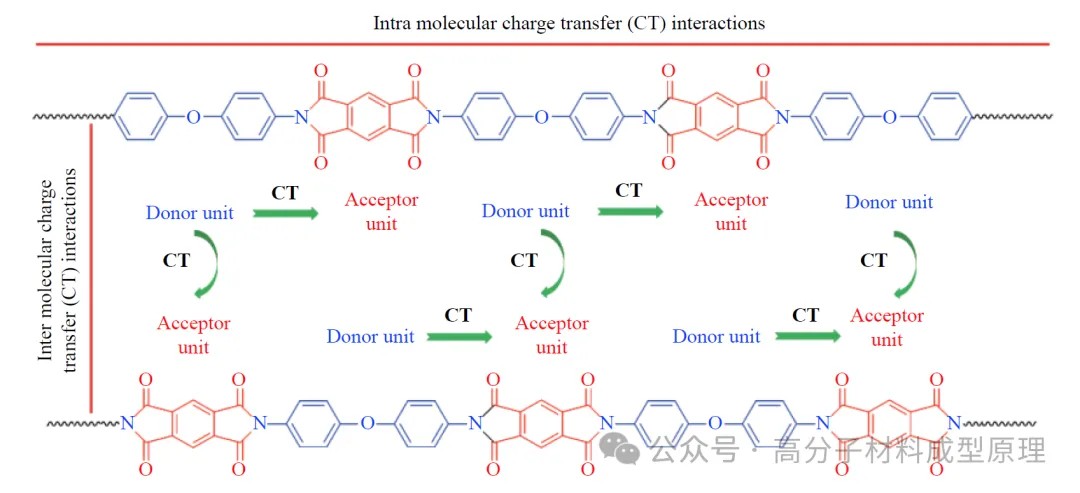
The most direct and effective way to suppress the CTC effect and make PI colorless and transparent is to modify the structure by changing the intermolecular forces and electron cloud distribution to disrupt the formation conditions of the CTC effect, thereby reducing the absorption of visible light. It is possible to use dianhydride with weak electron withdrawing groups and diamine monomers with weak electron donating groups to reduce charge transfer between molecular chains, thereby producing colorless and transparent PI films.

It is also possible to introduce some strong electronegative groups that weaken the strength of electron donors and acceptors, such as trifluoromethyl and sulfone groups containing fluorine atoms with high electronegativity, which weaken the strength of electron acceptors and electron acceptors, and reduce the charge transfer ability; Replacing the benzene ring with an aliphatic ring can disrupt the conjugated structure on the aromatic PI chain segment, block charge transfer, and introduce an aliphatic ring structure (such as trans-1,4-bis (2,3-dicarboxyphenoxy) cyclohexanedianhydride); Introducing large substituent groups can occupy a large free volume, causing the molecular chain structure to become loose and making it difficult to transfer charges; The introduction of asymmetric and rigid non coplanar structures will reduce the symmetry of the molecular chain structure, disrupt the conjugation between chains, and suppress charge transfer [16]. These methods to some extent hinder the transfer of charges, thereby suppressing the CTC effect and making PI appear colorless and transparent.
But these methods will cause a certain degree of decrease in the thermal performance of the material. The coefficient of thermal expansion (CTE) sharply increases, exceeding 5.0 × 10⁻⁵ K-1. The glass transition temperature (Tg) is also greatly affected, dropping to 330 ℃ or even below 330 ℃. The heat resistance weakens, and the thermal decomposition temperature decreases, with the 5% thermal weight loss temperature (Td5) dropping below 450 ℃. Therefore, while modifying PI with transparency, it is also necessary to consider maintaining its thermal performance.

The most direct way to maintain the original thermal performance of PI is to enhance the intermolecular interaction forces. Chen et al. introduced acyl chlorides into amide structures to form hydrogen bonding interactions, resulting in CPI films with a Tg greater than 360 ℃ and a CTE of only 1.3 × 10⁻⁵ K − 1. The optical transmittance (T400nm) remained at 81% at 400nm. Aggregated inorganic nanoparticles can also be introduced, which, due to their hard core structure, improve optical performance while ensuring the thermal performance of PI.
The CPI made from modified PI has good transparency and heat resistance, and its bending resistance is also an important challenge for CPI as a foldable display device. Ahn et al. [18] conducted bending performance tests on the prepared CPI film. After 200000 bending cycles, the surface before and after bending was observed by scanning electron microscopy (SEM), and it was found that the CPI film did not show surface damage, indicating that CPI has good bending resistance.

CPI already has good low dielectric properties, chemical corrosion resistance, wear resistance, and impact resistance. However, for flexible foldable displays, in order to further improve the comprehensive performance of CPI materials in foldable screen applications, other materials are usually sprayed or deposited on the surface to enhance their usability. Wu [20] prepared a highly transparent interlayer structure of silicon dioxide passivation layer on CPI substrate (Figure 8), which enhanced the transmittance and resistivity, further improving the wear resistance of CPI film.

4. Application of CPI film
Although the durability and transparency of CPI film as a foldable mobile phone screen cover are slightly inferior to UTG, UTG has high technical barriers, high production costs, and poor flexibility. So CPI film has a large market share in the foldable mobile phone market. Currently, multiple mobile phone manufacturers use CPI film as the foldable screen cover for their phones (Figure 9). The next stage of foldable screen phones may be a curled phone in the future, which will further highlight the flexibility advantage of CPI. By modifying CPI to improve transparency and mechanical strength, CPI's position in the field of flexible displays is irreplaceable.


