
 English
abstract
This study focuses on the construction of ultra precision nanostructures of polycarbonate (PC) - based antireflective ar antireflective films by molecular self-assembly technology, and further explores its process and internal mechanism. Based on the self-assembly behavior of amphiphilic block copolymer on the surface of PC substrate, the antireflective film with regular nanostructure was successfully prepared, which significantly improved the optical transmittance of PC material in the visible light band. The size, shape and arrangement of nanostructures can be precisely controlled by accurately adjusting the process parameters of self-assembly, such as solution concentration, temperature and evaporation rate. Combined with a variety of characterization methods, the thermodynamic and dynamic factors in the process of molecular self-assembly were systematically analyzed, and the internal mechanism of nanostructure formation was revealed. This study provides a new technical path and theoretical support for the preparation of high-performance PC antireflective ar antireflective coatings.
1、 Introduction
As an important optical polymer material, polycarbonate (PC) has high transparency, good mechanical properties and processing properties, and is widely used in optical devices, display screens, lighting and other fields. However, the high reflectivity of PC material surface leads to the loss of light energy, which limits its application in some scenes that require strict optical performance. AR (anti reflection) antireflection film can effectively reduce the reflectivity of the material surface and improve the light transmittance, which has become the key technology to improve the optical performance of PC. The traditional preparation methods of antireflective coatings, such as physical vapor deposition and chemical vapor deposition, have many problems, such as complex equipment, high cost and harsh environmental requirements. As a new nano manufacturing technology, molecular self-assembly technology can spontaneously form ordered nanostructures on the substrate surface by using the weak interaction between molecules, which provides a simple, efficient and low-cost way for the preparation of ultra precision nanostructure antireflective films. The ultra precision nanostructure of AR Antireflective and antireflective coatings on PC by molecular self-assembly can not only significantly improve the optical properties of PC, but also has broad application prospects and development potential.
2、 Experimental part
2.1 experimental materials
The optical grade PC film is selected as the substrate material, its thickness is 1mm, and the visible light transmittance is greater than 90%. Amphiphilic block copolymer polystyrene-b-polymethylmethacrylate (PS-b-PMMA) as a self-assembly building unit, its molecular weight is 10kDa for PS segment and 15kDa for PMMA segment, respectively. Toluene is selected as the organic solvent, which is analytically pure and used to dissolve block copolymers.
2.2 preparation of PC antireflective ar antireflective coatings by molecular self-assembly
PS-b-PMMA block copolymer was dissolved in toluene and prepared into solutions with different concentrations ranging from 0.5wt% to 3wt%. The PC film substrate is ultrasonically cleaned with acetone and ethanol for 15 minutes to remove surface impurities, and then dried in a clean environment for standby. The block copolymer solution was uniformly coated on the surface of PC substrate by spin coating method. The spin coating speed was 2000-5000rpm and the time was 30-60 seconds. After coating, the samples were placed in a temperature controlled oven and annealed at 50-100 ℃ for 1-5 hours, so that the block copolymer molecules self assemble on the surface of PC substrate to form nanostructures. In order to study the effect of volatilization rate on self-assembly, some samples were dried under different humidity conditions.
2.3 characterization means
The surface morphology and size of the self-assembled nanostructures were characterized by atomic force microscopy (AFM). The scanning range was 5 μ m × 5 μ m, and the resolution was 512 × 512 pixels. The internal morphology and microstructure of the nanostructure were observed by transmission electron microscope (TEM), and the acceleration voltage was 200kV. The elemental composition and chemical state of the nanostructure surface were analyzed by X-ray photoelectron spectroscopy (XPS). The optical transmittance of PC films before and after self-assembly was measured by UV-Vis spectrophotometer. The wavelength range was 300-800nm.
3、 Results and discussion
3.1 morphology and size of self assembled nanostructures
The results of AFM and TEM showed that highly ordered columnar nanostructures were formed on the surface of PC substrate when the concentration of PS-b-PMMA block copolymer solution was 1.5wt%, the spin coating speed was 3000rpm, the annealing temperature was 80 ℃, and the annealing time was 3 hours. The diameter of the columnar structure is about 30nm, the height is about 50nm, and it shows a regular hexagonal close packed arrangement in a large area (Fig. 1). With the increase of solution concentration, the size of nanostructures increases gradually, and the order of the arrangement decreases gradually; When the concentration exceeds 2.5wt%, the aggregation and fusion of nanostructures occur. The increase of spin coating speed will reduce the size of the nanostructure, because the volatilization rate of the solution is accelerated at high speed, and the molecules have no time to fully diffuse and assemble. The influence of annealing temperature and time on nanostructures is also significant. Appropriately increasing the annealing temperature and prolonging the annealing time will help to rearrange the molecular chain and optimize the structure, but too high temperature and too long time will lead to the thermal degradation and deformation of nanostructures.
3.2 effect of self-assembly process parameters on nanostructures
Solution concentration is one of the key factors affecting self-assembled nanostructures. At low concentration, the intermolecular distance is large and the interaction is weak, which is conducive to the formation of small and ordered nanostructures; With the increase of concentration, the intermolecular interaction is enhanced, and the nucleation and growth rate in the process of self-assembly are accelerated, resulting in the increase of the size of nanostructures, but also prone to structural defects and disordered arrangement. Spin coating speed mainly affects the distribution and volatilization rate of solution on the substrate surface. High rotation speed makes the solution rapidly spread and volatilize, which limits the diffusion and assembly time of molecules, so as to obtain smaller nanostructures; At low rotation speed, the solution volatilizes slowly and the molecules have more time to assemble, but it may lead to uneven film thickness and structural instability. Annealing temperature and time have important effects on the mobility and self-assembly driving force of molecular chains. At appropriate temperature, the thermal motion of molecular chains is enhanced, which can overcome the energy barrier and rearrange to form a more stable nanostructure; Due to insufficient annealing time, the molecular chain can not be fully adjusted to the lowest energy state, and the structural order is poor; Excessive annealing may lead to the degradation of molecular chains and structural damage.
3.3 mechanism of molecular self-assembly to form nanostructures
In the process of molecular self-assembly, the PS segment of PS-b-PMMA block copolymer has good compatibility with PC substrate, while the PMMA segment tends to aggregate with each other to reduce the free energy of the system. In the process of solution volatilization and annealing, a variety of weak interaction forces such as van der Waals force, hydrogen bond and entropy drive between molecules promote the spontaneous arrangement of block copolymer molecules on the surface of PC substrate to form nanostructures. Firstly, after the solution was coated on the surface of PC substrate, with the volatilization of the solvent, the block copolymer molecules began to aggregate and form initial nuclei. Then, during the annealing process, the molecular chains are rearranged through overheating movement to further optimize the structure, and finally form a stable nanostructure. According to the thermodynamic theory, the self-assembly process tends to minimize the free energy of the system, and the formation of nanostructures is the result of the balance of various interactions and energy factors. Kinetic factors such as solvent volatilization rate and molecular chain movement ability also have an important impact on the self-assembly process, which determines the formation rate and final morphology of nanostructures.
3.4 optical properties of PC antireflective ar antireflective coatings
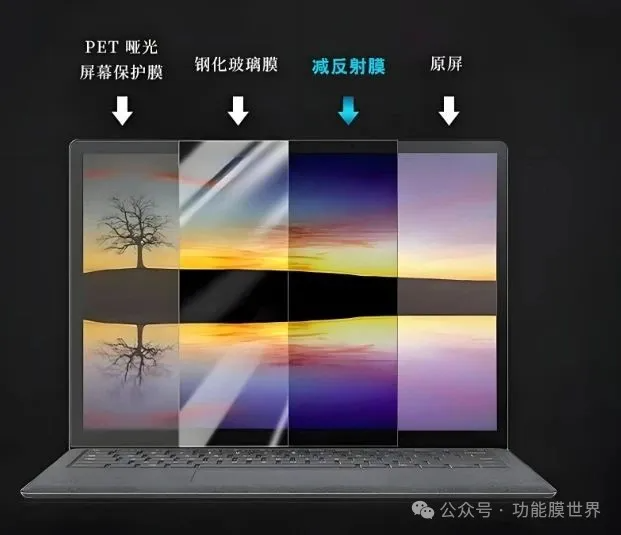
The UV VIS spectrophotometer test results showed that the average transmittance of PC antireflection ar antireflection film prepared by molecular self-assembly in the visible light band increased from 90% to more than 95%, and the reflectivity decreased significantly (Fig. 2). This is because the self-assembled nanostructure builds a gradient refractive index layer on the surface of PC, which effectively reduces the reflection of light on the material surface. The size and arrangement of nanostructures have a certain matching relationship with the wavelength of light, which can further enhance the antireflection effect through optical effects such as light interference and scattering. Compared with the traditional antireflective film, the molecular self-assembled antireflective film prepared in this study has wider antireflective band and better optical stability while maintaining high transmittance.
4、 Conclusion
In this study, AR antireflection and antireflection coatings with ultra precision nanostructures were successfully constructed on the surface of PC substrate by molecular self-assembly technology. The influence of self-assembly process parameters on nanostructures was systematically studied, and the thermodynamic and kinetic mechanisms of molecular self-assembly to form nanostructures were revealed. By accurately regulating the self-assembly process, the size, shape and arrangement of nanostructures can be precisely controlled, which significantly improves the optical properties of PC materials. As a simple, efficient and low-cost nano manufacturing method, molecular self-assembly technology provides a new technical approach and theoretical basis for the preparation of high-performance PC antireflective ar antireflective coatings. Future research can further expand the application of molecular self-assembly technology in other optical materials, explore the complex physical and chemical phenomena in the process of self-assembly, and develop optical thin film materials with better performance and multi-function integration.


